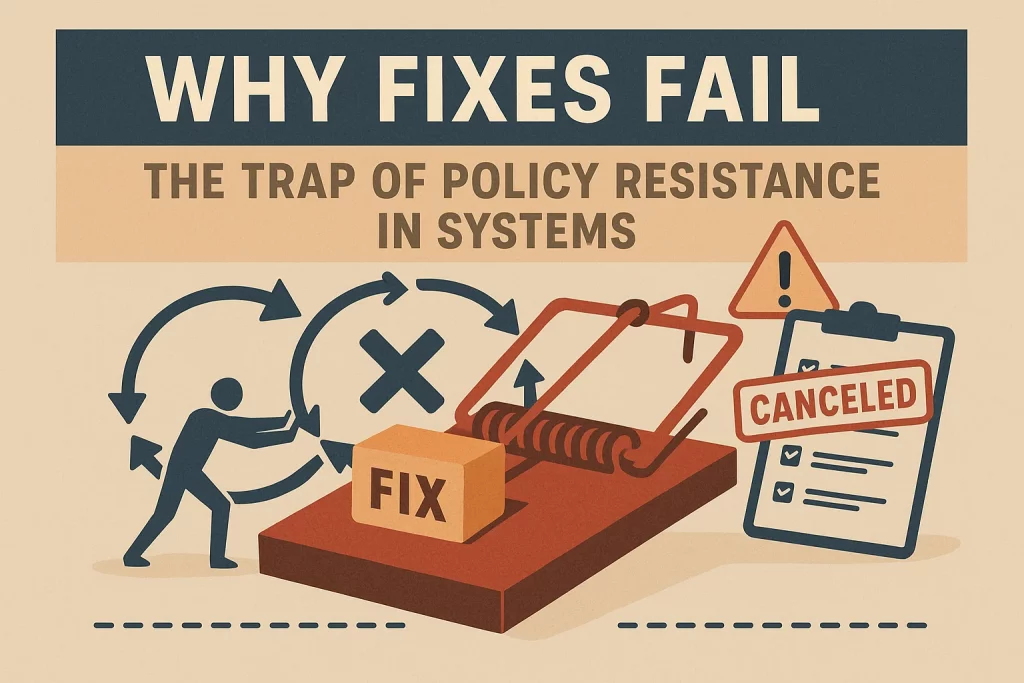
In colonial India, the British government faced a problem: there were too many cobras in Delhi. To solve this, they created a perfectly logical policy: they offered a bounty for every dead cobra.
At first, it worked. People killed cobras for the reward. But soon, enterprising locals realized they could earn a living by breeding cobras to kill and sell to the government. When the government realized this and cancelled the bounty, the breeders released the now-worthless snakes into the wild.
The result? The cobra population was higher than before the “solution” began.
This phenomenon is known in System Dynamics as Policy Resistance. It explains why our best-intended “fixes”—from diet plans to war on drugs to road widening projects—often fail to solve the problem, or even make it worse.
What is Policy Resistance?
Policy Resistance is the tendency of a complex system to defeat the interventions designed to change it.
When we intervene in a system, we often treat it like a lifeless machine. We think, “If I push this button, X will happen.” But social and biological systems are not machines; they are living networks of feedback loops. When you push them, they push back.
The Central Mechanism: Compensating Feedback
Peter Senge, a student of Jay Forrester, calls this “Compensating Feedback.” When you try to change a system’s behavior without changing its underlying structure, the system adjusts its internal flows to counteract your effort and restore the status quo.
The Illusion of the “Side Effect”
We often blame these failures on “unintended side effects.” In System Dynamics, there is no such thing as a side effect. There are only effects.
Some effects are anticipated (the ones we wanted). Others are unanticipated (the ones we ignored).
- The Linear View: I widen the road $\rightarrow$ Traffic jams disappear.
- The Systems View: I widen the road $\rightarrow$ Driving becomes faster $\rightarrow$ More people decide to drive instead of taking the train $\rightarrow$ The road fills up again (Induced Demand).
The traffic jam didn’t return because of bad luck; it returned because the system reacted rationally to the new condition (easier driving).
Why We Get It Wrong: Bounded Rationality
Why do smart leaders constantly trigger policy resistance? The answer lies in Bounded Rationality.
We cannot see the whole system. We focus on the local symptom.
- The Problem: A city has high heroin addiction.
- The Fix: Arrest the dealers (reduce supply).
- The System Reaction: With fewer dealers, the street price of heroin rises. Higher prices mean addicts must commit more crimes to fund their habit. The remaining dealers earn higher profits, which allows them to buy better weapons and recruit younger sellers.
- The Result: The drug rate stays the same, but crime and violence increase.
We focused on the “stock” of dealers, but ignored the “feedback loop” of market economics.
How to Overcome Resistance
If systems push back, should we just give up? No. But we must change how we intervene.
1. Stop attacking the Symptom
Policy resistance almost always comes from attacking the symptom (the fever) rather than the source (the infection).
- Example: Rent control attacks the symptom (high prices). The system resists by reducing the supply of new apartments (landlords stop building), creating a housing shortage.
2. Find the “High Leverage” Point
Donella Meadows argued that we often push the system in the wrong place. We try to change parameters (numbers, subsidies, taxes) when we should be changing goals or feedback loops.
- Instead of widening the road (parameter), change the goal of the transportation system from “moving cars” to “moving people” (perhaps by creating dedicated bus lanes or telecommuting incentives).
3. Let the System Do the Work
The best interventions use the system’s own energy.
- In the 1970s, the US government wanted to reduce energy consumption. Instead of just passing laws, they required appliances to display energy-efficiency labels. This created a new feedback loop: customers could see the cost of electricity. Customers voluntarily bought efficient machines, and manufacturers voluntarily improved their designs to compete. The system fixed itself.
Conclusion
Policy Resistance is the systems thinker’s reality check. It teaches us humility. It reminds us that we cannot simply impose our will on a complex system. When a problem persists despite our best efforts, it is not because the system is broken; it is because the system is working exactly as it was designed. To fix the problem, we must stop fighting the system’s behavior and start redesigning its structure.