In the early days of a startup, or the beginning of a viral trend, everything looks like a rocket ship. Sales double every month. Users flood in. Managers look at the charts and predict: “If we keep growing at this rate, we’ll be bigger than Amazon in three years!”
But they almost never are. Eventually, the rocket ship slows down. The doubling stops. The line on the chart goes flat.
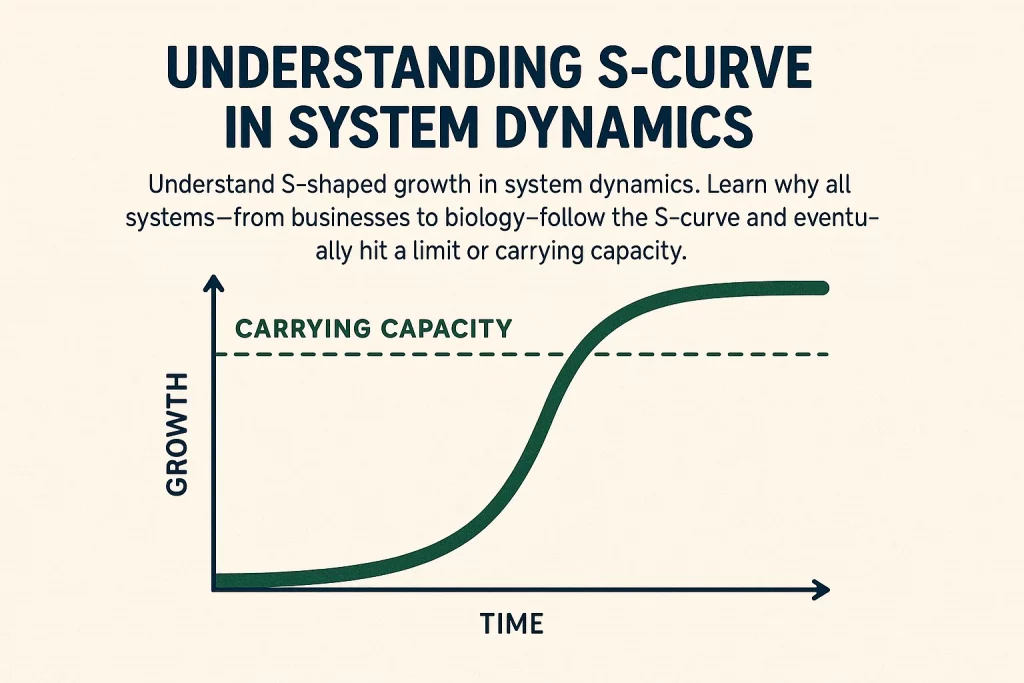
In System Dynamics, this pattern is called S-Shaped Growth (or the Sigmoid Curve). It is the fundamental law of nature and business: nothing grows forever. Understanding the S-Curve is the only way to predict when a boom will turn into a plateau, saving you from the dangerous trap of expecting infinite expansion.
The Anatomy of the S-Curve
The S-Curve is fascinating because it is actually a story of two different feedback loops fighting for control. It is a “tug-of-war” that shifts over time.
1. The Engine: Reinforcing Loop (R) 🚀
Every growth story starts with a Reinforcing Loop.
- The Mechanism: Success breeds success. A happy customer tells a friend. A virus infects a host, who infects two others.
- The Result: Exponential growth. This creates the bottom, curved-up part of the “S.”
2. The Brake: Balancing Loop (B) 🛑
Lurking in the background is a Balancing Loop. This loop represents the system’s limits.
- The Mechanism: Constraints. There are only so many customers in the market. There is only so much food in the forest.
- The Result: As the system grows, this loop gets stronger and pushes back, eventually slowing the growth to zero.
The Three Phases of Growth
To manage a system effectively, you have to know which phase of the S-Curve you are currently standing in.
Phase 1: Accelerating Growth (The Early Days)
In the beginning, the system is small, and the limit is far away. There is plenty of “empty space” to grow into.
- Dominance: The Reinforcing Loop is in total control.
- The Feeling: Excitement. Everything you try works. “The sky is the limit.”
Phase 2: The Inflection Point (The Shift)
This is the critical moment—often the middle of the “S”—where the behavior changes. The system is still growing, but the rate of growth starts to slow down.
- Dominance: The Balancing Loop is waking up. It is starting to apply the brakes.
- The Feeling: Confusion. “We’re spending the same amount on marketing, but getting fewer new customers than last month.”
Phase 3: Saturation (The Plateau)
The system hits its Carrying Capacity. The “empty space” is gone.
- Dominance: The Balancing Loop has won.
- The Feeling: Stagnation. The only way to get a new customer is to wait for an old one to leave (replacement). The system has reached equilibrium.
The Concept of Carrying Capacity
The top of the S-Curve is defined by the Carrying Capacity. In biology, this is the maximum population an ecosystem can support (food, water, space). In business, this is the Total Addressable Market (TAM).
The Dangerous Mistake The biggest failure in management is assuming the Carrying Capacity is infinite.
- If a CEO looks at Phase 1 (Exponential Growth) and projects that line straight up forever, they will over-hire, over-build, and over-spend.
- When the system inevitably hits Phase 2 (Inflection), the company hits a wall. They have built a structure for a giant market that doesn’t exist. This leads to layoffs and collapse.
Jumping the Curve
Does the S-Curve mean a business is doomed to die? Not necessarily. But it means the current strategy is doomed to stall.
Great companies understand the S-Curve. They know they cannot ride the same wave forever.
- Apple: When the iPod S-Curve flattened (saturation), they didn’t just try to sell more iPods. They launched the iPhone, creating a new S-Curve stacked on top of the old one.
- This is called “Jumping the Curve.” You must start the new engine (Innovation) before the old engine (Current Product) dies.
Conclusion
S-Shaped Growth is the reality check for linear thinkers. It teaches us that every system has a limit. By recognizing the shift from the Reinforcing Phase (growth) to the Balancing Phase (saturation), you can stop fighting the inevitable slowdown and start planning for the next innovation. Growth never happens in a straight line; it happens in curves.