When a project runs late, we blame the “unexpected delays.” When a business loses money, managers blame the “economy” or “aggressive competitors.” When a relationship turns sour, we almost always blame the “other person.”
It is human nature to look for the cause of a problem outside of ourselves. In science, this is called the Exogenous View (meaning “generated from outside”). We like this view because it gets us off the hook.
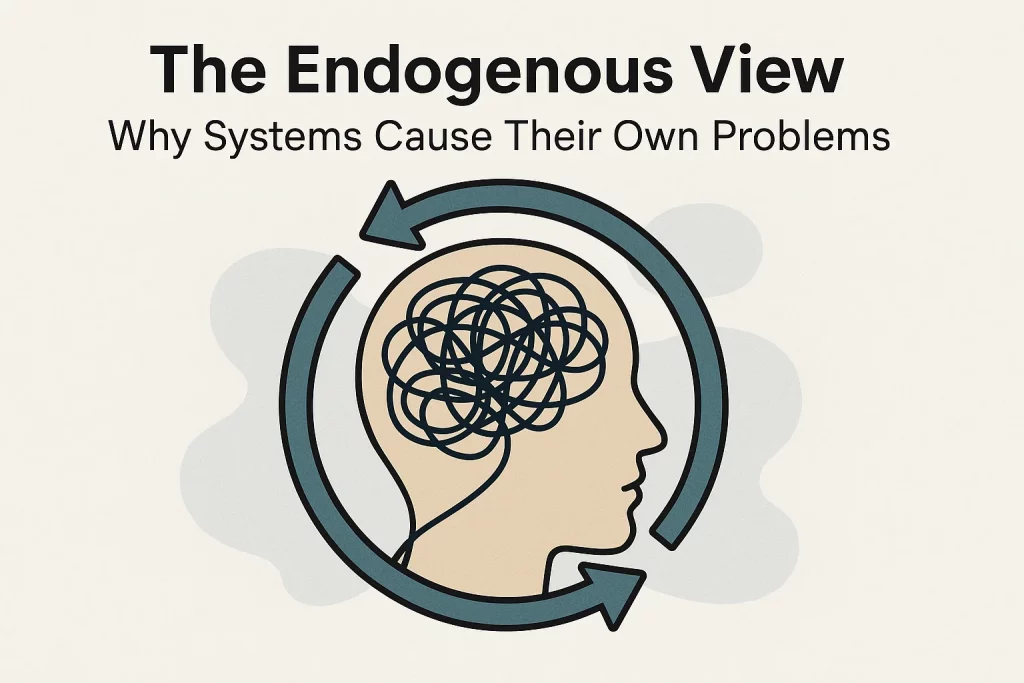
But System Dynamics teaches us a harder, yet more powerful truth: the Endogenous View. This principle states that the behavior of a system is generated by its own internal structure, not by external forces. While outside events might trigger a reaction, the nature of that reaction—whether the system crashes, bounces back, or spirals out of control—is determined entirely by the feedback loops, policies, and rules inside the system itself.
Defining the Endogenous Perspective
To understand this concept, we have to look at the words themselves. Endogenous comes from the Greek endo (meaning “inside”) and gen (meaning “origin” or “birth”). It literally means “arising from within.”
Jay W. Forrester, the founder of System Dynamics, argued that the biggest mistake decision-makers make is treating problems as if they are imposed on them by bad luck or external enemies.
- The Exogenous Thinker says: “The stock market crash destroyed my company.” (Blaming the storm).
- The Endogenous Thinker says: “My company’s debt structure was so fragile that a market dip caused it to collapse.” (Blaming the ship design).
The Slinky Analogy: The Best Example
The best way to understand the Endogenous View is to think about a Slinky (the coiled spring toy).
Imagine you are holding a Slinky by one end. You move your hand up and down sharply. The Slinky starts bouncing wildly, stretching and compressing.
- The Exogenous View: If you ask a child, “Why is the Slinky bouncing?”, they will point to your hand. “It’s bouncing because you are moving it.”
- The Endogenous View: A systems thinker asks a different question: “If I held a heavy rock and moved my hand the same way, would it bounce like that?”
The answer is no. The rock would just move up and down with your hand. The Slinky bounces because of its internal structure—the coils, the flexibility, and the tension. Your hand provided the energy (the trigger), but the structure caused the behavior (the bounce).
Triggers vs. Causes
To master the Endogenous View, you must learn to distinguish between the trigger and the cause.
The External Trigger
An external event is usually just a trigger. It is the spark that crosses the system boundary.
- Example: A competitor lowers their price by 10%.
- Example: A virus enters your body.
The Internal Cause
The cause is how the system processes that trigger through its internal feedback loops.
- Example: The company has a policy that automatically matches competitor prices. This triggers a “price war” loop that destroys all profits. The competitor provided the spark, but the company’s policy caused the collapse.
- Example: The virus enters the body, but the high fever and inflammation you feel are actually caused by your own immune system’s over-reaction to the intruder.
Why This View is Empowering
At first, the Endogenous View feels harsh. It forces us to admit, “I designed the system that is creating this problem.” It removes the ability to blame bad luck.
However, it is actually the most optimistic way to view the world.
- If the problem is Exogenous (caused by the economy, the weather, or luck), you are a victim. You have no control. You can only wait and hope.
- If the problem is Endogenous (caused by your structure), you are a designer. You have the power to fix it.
By accepting that “structure causes behavior,” you stop fighting external enemies you can’t control and start redesigning the internal rules, habits, and policies that you can control.
Conclusion
The Endogenous View is the defining philosophy of System Dynamics. It shifts our focus from “Who is to blame?” to “What is the structure?” While external events happen to us, the way we respond—our resilience, our stability, or our chaos—is determined by the system we have built. By owning the structure, we gain the power to change the outcome.