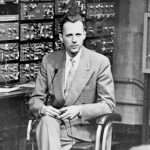
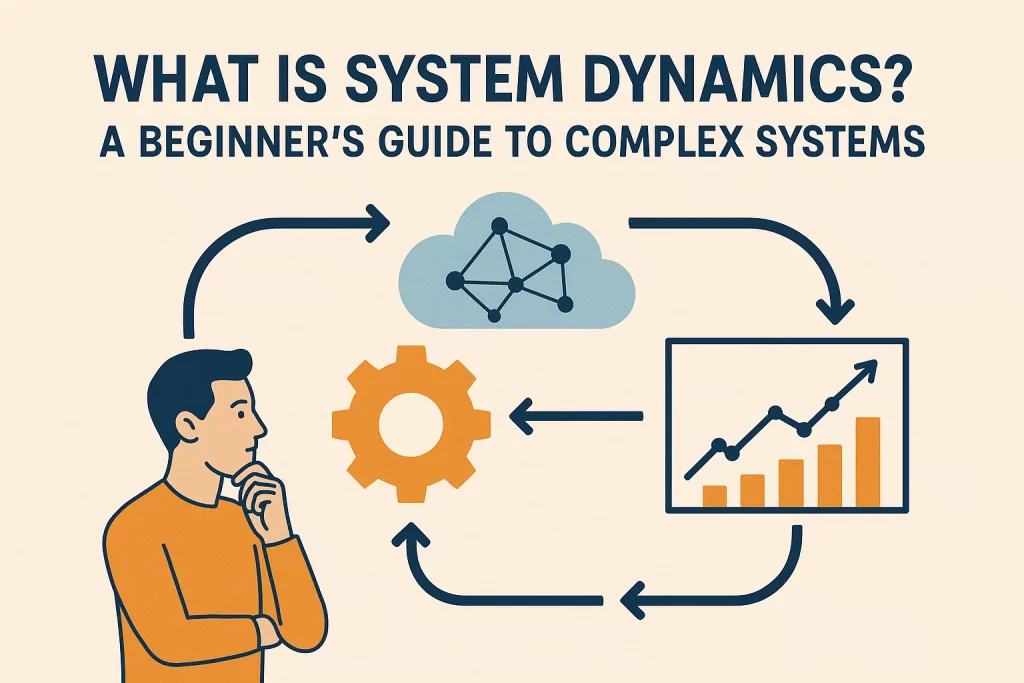
Have you ever noticed how many complex problems like high inventory cycles in a business, the boom and bust of a housing market, or slow results from a new public policy, seem to keep repeating themselves? After managers try to fix them, the problems often get worse or just pop up somewhere else. The creator of System Dynamics (SD), Jay W. Forrester, found the reason why: the problem is not caused by outside events, but by the system’s own structure.
System Dynamics is a rigorous, scientific methodology that maps, models, and simulates the behavior of complex systems over time. It was developed at MIT starting in the 1950s. SD operates on one core principle: structure causes behavior. By understanding the internal connections, delays, and policies within a system, you can uncover the true cause of its patterns, predict its future behavior, and find the high-leverage points for lasting change.
The Central Role of Feedback Loops
The most fundamental concept in System Dynamics is the feedback loop. Feedback is the principle of circular causality, meaning an action in a system eventually comes back to influence itself, creating a closed circle of cause and effect. Feedback loops are the source of all dynamic behavior—whether it is growth, stability, or wild oscillation.
Reinforcing (Positive) Feedback Loops (R)
Reinforcing loops amplify change in a system, pushing it further in the direction it is already moving. They are responsible for periods of exponential growth or rapid accelerated collapse.
- Mechanism: An increase in one variable leads to a further increase, which causes an even greater increase in the first variable, and so on. This creates a powerful virtuous cycle (like success) or a vicious cycle (like a downward spiral).
- Example: A company’s strong reputation leads to more customers. More customers bring in more revenue. More revenue allows the company to invest more in quality, which boosts the reputation even higher.
Balancing (Negative) Feedback Loops (B)
Balancing loops resist change in a system. Their function is to pull a variable toward a specific goal or desired equilibrium. They are responsible for creating stability and goal-seeking behavior.
- Mechanism: When a variable deviates from its desired target, the loop triggers an opposing action that forces the system back into balance.
- Example: A person’s body temperature system. If the temperature (variable) goes above the goal (98.6°F), the body sweats (opposing action) to bring the temperature back down.
The Building Blocks: Stocks and Flows
System Dynamics uses stocks and flows to physically model the process of accumulation. This structure is essential for capturing inertia and memory in a system, showing why a system cannot change instantly.
Stocks (Levels) 💧
A Stock (often called a level) is an accumulation within the system. It is a measurement of the state of the system at any given moment. Stocks are the source of the system’s inertia and memory; they are what gives the system its bulk and takes time to change.
- Examples: Inventory in a warehouse, the Employee Population in an organization, the amount of Money in a bank account, or the amount of Pollution in a lake. You can see a stock.
Flows (Rates) 🌊
A Flow (or rate) is the activity that changes the level of a stock. Flows represent the movement of resources, people, or information either into (Inflow) or out of (Outflow) a stock over a unit of time.
- Key Insight: Flows are the control points of the system. The rate of a flow is determined by the decision rules or policies of the system’s actors. For instance, the Hiring Flow is controlled by the company’s hiring policy, and the Production Flow is controlled by the operations policy.
System Dynamics provides the analytical tools to test the principle that a complex system’s structure—the combination of its loops, stocks, and flows—determines its dynamic behavior over time. Understanding this structure reveals the best points to intervene.
Sources of Dynamic Complexity
While loops and stocks/flows define the structure, two elements are the primary causes of the complicated, often unexpected behaviors seen in real-world systems.
Time Delays ⏳
A Time Delay is a gap in time between an action and its resulting effect, or between recognizing a problem and being able to respond to it. Delays are the number one cause of system oscillation (repeating cycles) and instability.
- Impact: Delays often cause a system to overshoot its goal. If it takes three months for a sales team’s efforts to show up in the revenue figures, managers might mistakenly increase marketing spending too much, leading to wildly fluctuating sales and excess inventory.
Nonlinearity 📈
Nonlinearity means that the relationship between two variables is not a simple straight line; the effect is often disproportionate to the cause. Most real-world relationships are nonlinear.
- Thresholds: Nonlinearity often involves thresholds. If an employee’s workload is slightly increased, their productivity might stay the same (a linear change). But if the workload increases past a certain breaking point (a nonlinear threshold), that slight change could cause a sudden, massive drop in productivity or burnout.
Conclusion
System Dynamics is the rigorous methodology that translates the philosophical ideas of systems thinking into practical, measurable models. By focusing on the continuous interaction of feedback loops, stocks, and flows, SD allows you to simulate the system and truly understand why certain behaviors persist. This understanding is key to discovering the deep leverage points—the places where a small, well-timed policy change can break a vicious cycle or stabilize an unstable flow, leading to major, long-term improvement in the system’s performance.