We see it everywhere. The economy booms, then crashes. A store has empty shelves one week, then overflowing clearance bins the next. Wildlife populations explode, then starve.
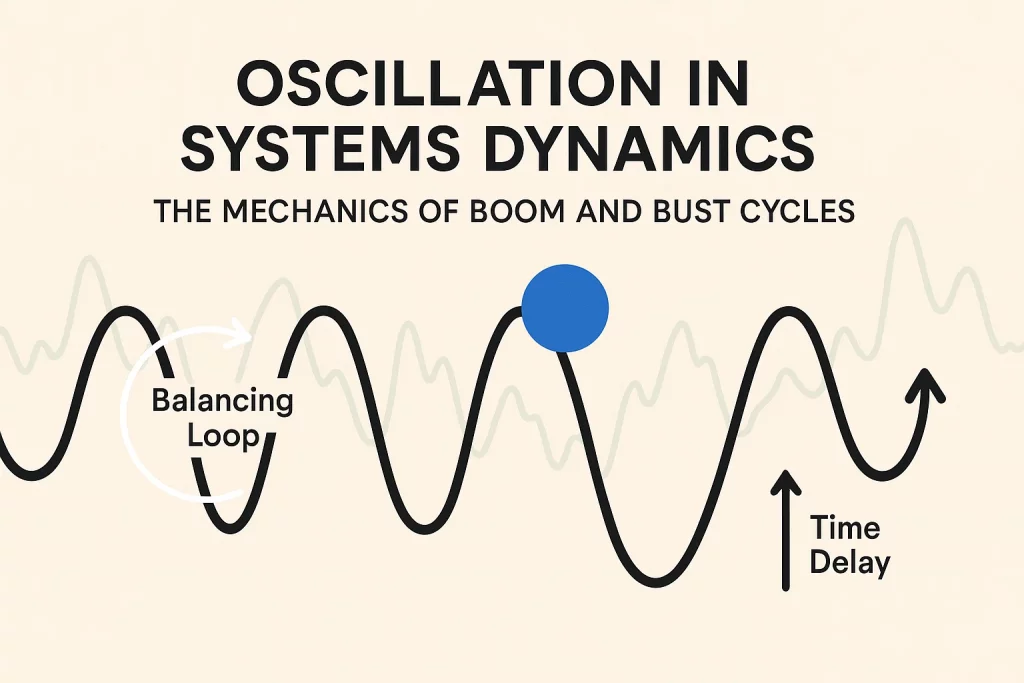
This repeating up-and-down pattern is called Oscillation. It is one of the most common and destructive behaviors in complex systems. In System Dynamics, oscillation isn’t a mystery or a result of bad luck. It has a very specific mechanical cause. If you see a system swinging back and forth like a pendulum, you can be 100% sure of two things:
- There is a Balancing Loop trying to reach a goal.
- There is a Time Delay in the system’s reaction.
The Recipe for Oscillation
Oscillation is what happens when a “good” intention (trying to reach a goal) meets a “bad” reality (clumsy, delayed reactions).
To create oscillation, you need two ingredients mixed together:
Ingredient 1: The Balancing Loop (The Goal Seeker) ⚖️
Every oscillating system is trying to reach a target.
- Inventory Manager: Wants to keep exactly 100 TVs in stock.
- Thermostat: Wants to keep the room at exactly 70°F.
- Predators: Want to eat enough prey to survive.
If the system had no delay, the Balancing Loop would work perfectly. It would smoothly move the system to the goal and hold it there.
Ingredient 2: The Time Delay (The Sluggishness) ⏳
The problem starts when there is a gap between taking an action and seeing the result.
- The Order Delay: The manager orders TVs today, but they don’t arrive for 4 weeks.
- The Temperature Delay: The furnace turns on, but it takes 10 minutes for the heat to reach the thermostat.
How the Cycle Works (The “Shower” Effect)
The best way to understand oscillation is the classic “Scalding Shower” scenario.
- The Goal: You want warm water.
- The Gap: The water is freezing.
- The Action: You turn the handle way up to “Hot.”
- The Delay: The hot water has to travel through 20 feet of pipe. For 10 seconds, the water stays freezing.
- The Over-Reaction: Because you don’t feel the heat yet, you assume you didn’t turn it enough. You turn the handle even more.
- The Overshoot: Suddenly, the hot water hits. But because you turned it too far, it’s scalding hot! You missed the goal.
- The Correction: You panic and spin the handle back to cold.
- The Repeat: The delay happens again. You wait, feel nothing, turn it more to cold… and suddenly you are freezing.
This cycle—Undershoot $\rightarrow$ Action $\rightarrow$ Delay $\rightarrow$ Overshoot—is the mechanics of a Boom and Bust cycle.
Real-World Oscillations
This same structure destroys value in business and nature every day.
The Inventory Cycle (The Bullwhip Effect)
In business, this is famous. A retailer sees a small jump in sales. They panic and order double to avoid running out. The factory sees the double order and thinks the market is booming, so they build a new factory. By the time the factory is built (delay), the customer demand has gone back to normal. The factory now has massive excess capacity and inventory. They have to fire workers and sell products at a loss. Boom and Bust.
The Biological Cycle
In nature, predator and prey populations oscillate.
- The Boom: Rabbits have plenty of grass, so they multiply.
- The Delay: It takes time for the Lynx (predator) population to grow in response to the extra food.
- The Overshoot: The Lynx population eventually explodes, eating too many rabbits.
- The Bust: The rabbits are wiped out. Now the Lynx starve and their population crashes. The grass grows back, and the cycle starts again.
How to Stop the Swing
If you are managing a system that is oscillating, your instinct is usually to react faster. This is wrong. Reacting faster in a delayed system usually makes the oscillation more violent.
The System Dynamics solution to oscillation is counter-intuitive:
- Reduce the Delays: If you can, use technology to get data faster or shorten shipping times.
- Be More Patient (Dampening): If you can’t fix the delay, you must slow down your reaction. Don’t turn the shower handle all the way. Turn it a little bit and wait for the delay to pass before you touch it again. You must ignore the short-term crisis to stabilize the long-term trend.
Conclusion
Oscillation is the signature of a system that is trying to balance itself but is too clumsy to do it smoothly. It is caused by the dangerous combination of a Balancing Loop and a Time Delay. Whether it’s a fluctuating stock market or a shower handle, the lesson is the same: when a system has delays, aggressive action leads to instability. To fix the cycle, you must learn to wait.