
“Give me a lever long enough and a fulcrum on which to place it, and I shall move the world.” — Archimedes
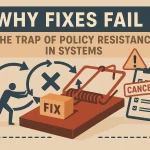
We all want to fix problems. Whether it is a failing project, a struggling business, or a climate crisis, we are looking for the “magic button” that will create a massive result. In System Dynamics, this is called a Leverage Point.
The late Donella Meadows, lead author of The Limits to Growth, famously observed that people naturally know where these points are, but they almost always push them in the wrong direction. We obsess over easy changes that have little effect, while ignoring the difficult changes that could transform the entire system.
Meadows developed a hierarchy of 12 Leverage Points. It is a ranked list of interventions, moving from the least effective (the surface) to the most effective (the core).
The Surface: Physical & Numerical Changes (Least Leverage)
These are the easiest things to change, but they rarely solve the problem. The system usually absorbs them and continues as before.
12. Constants, Parameters, and Numbers
- The Action: Changing the tax rate by 1%, increasing the minimum wage, or firing one person.
- The Reality: We fight huge political battles over these numbers, but they rarely change the system’s behavior. If you raise the tax (parameter) without fixing the leak (structure), the result is the same.
11. Buffers
- The Action: Increasing the size of a reservoir or a bank account.
- The Reality: Buffers stabilize a system (preventing crashes), but they don’t change why the crash was happening. A bigger bucket buys you time, but it doesn’t stop the leak.
10. Structure of Stocks and Flows
- The Action: The physical plumbing. Building a new highway or laying internet cables.
- The Reality: Once the concrete is set, physical structure is incredibly expensive and slow to change. It is high leverage during design, but low leverage after construction.
9. Delays
- The Action: Shortening the time between data and decision.
- The Reality: If a shower takes 30 seconds to get hot, you will turn the knob too far and burn yourself (oscillation). Reducing the delay makes the system more stable and easier to steer.
The Structure: Fixing the Wiring (Medium Leverage)
Now we enter the internal wiring of the system. This is where meaningful management happens.
8. Balancing Feedback Loops (The Stabilizers)
- The Function: These loops correct errors (e.g., a thermostat or inventory control).
- The Intervention: Strengthening the “correction” signal. If the system is crashing, the mechanism that catches it is too weak. You don’t need more inventory; you need a faster, stronger response to sales data.
7. Reinforcing Feedback Loops (The Engines)
- The Function: These drive growth or collapse (e.g., viral spread, compound interest).
- The Intervention: Instead of “pushing harder” against a runaway loop, weaken the gain. If a fire is growing, don’t just pour water (balancing); remove the fuel (weaken the reinforcing loop).
6. Information Flows (The Signal)
- The Function: Who knows what, and when?
- The Intervention: Adding a new feedback loop.
- Example: When homeowners were given an electric meter in their hallway (new information), energy use dropped instantly. No laws were passed, but behavior changed because the feedback was visible.
5. Rules
- The Function: The incentives, punishments, and constraints.
- The Intervention: Changing the laws of the game. If the rule of a university is “publish or perish,” professors will focus on research over teaching. Change the rule, and you change the behavior of the entire faculty.
The Core: Intent & Mindset (High Leverage)
These are the hardest things to change. But if you succeed, the system transforms completely.
4. Self-Organization
- The Function: The ability of the system to evolve and change its own structure.
- The Intervention: Encouraging diversity and experimentation. In biology, this is evolution. In business, it is R&D. If you crush variability to “maximize efficiency,” you kill the system’s ability to survive a crisis.
3. The Goal of the System
- The Function: The purpose that drives every feedback loop.
- The Intervention: Changing the “Why.”
- Example: If the goal of a hospital is “maximize profit,” every doctor and policy will align to that. If you change the goal to “maximize health,” the entire structure automatically realigns. The goal dictates the rules (Level 5) and the parameters (Level 12).
2. The Paradigm
- The Function: The unstated beliefs from which the system arises. The mindset.
- The Intervention: Changing the shared idea of reality.
- Example: Shifting from “The Earth is infinite” to “The Earth has limits” changes every economic and social goal. Paradigms are the soil in which systems grow.
1. Transcending Paradigms
- The Ultimate Leverage: The realization that no paradigm is “true.” It is the flexibility to let go of any worldview and adapt to what reality demands. It is the state of “not knowing” but staying willing to learn.
Conclusion
If you want to create small changes, work on the numbers (12-9). If you want to improve performance, work on the feedback loops and rules (8-5). But if you want to transform the system, work on the goals and paradigms (4-1).
Meadows taught us that the most powerful leverage points are not physical; they are mental. To change the world, you don’t just need new pipes or new tax rates; you need a new way of seeing.