If you want to build a bridge, you use math. You calculate the weight, the wind, and the strength of the steel. This is a “Hard” System. The goal is clear, the rules are fixed, and there is usually a “correct” answer.
But what happens when you try to fix a failing school system? Or a toxic workplace culture? Or a city’s homelessness crisis?
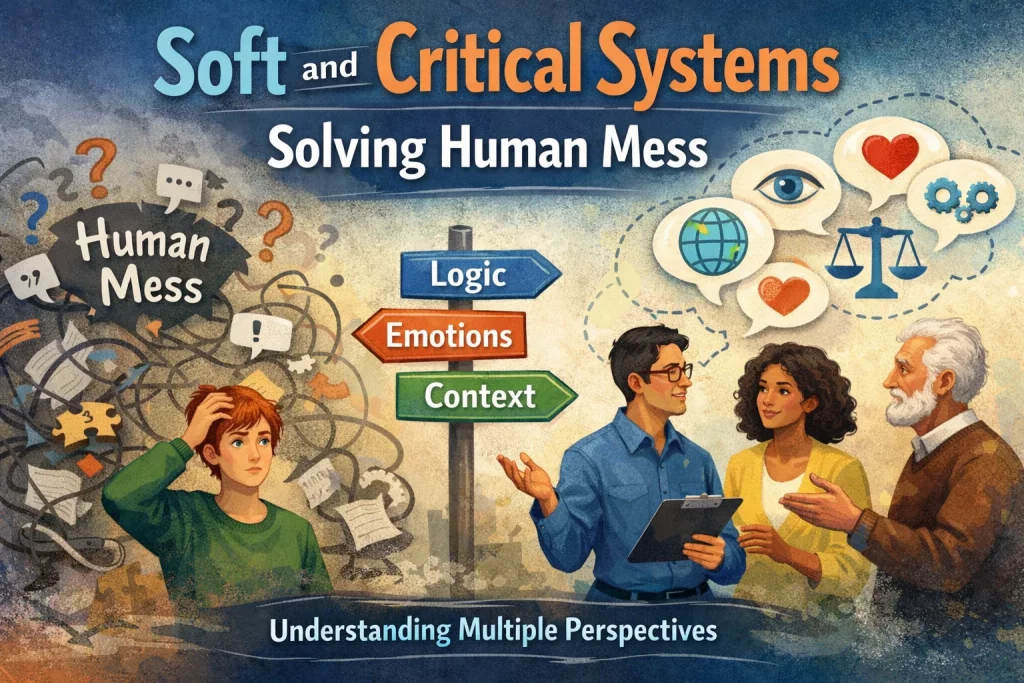
In these situations, there is no single “correct” math equation. Different people have different goals. The “rules” change based on who is in power. These are Soft and Critical Systems. In this new field of systems thinking, we stop looking at the world as a giant machine and start looking at it as a messy web of human perspectives.
The Shift from “Hard” to “Soft”
The biggest difference between the systems we studied before (like System Dynamics) and Soft Systems is the Human Factor.
In a “Hard” system, we assume everyone agrees on the goal. We just need to figure out how to get there. In a “Soft” system, we realize that people rarely agree on what the problem even is.
| Hard Systems Thinking | Soft Systems Thinking |
| Focuses on efficiency and “how.” | Focuses on learning and “what.” |
| Assumes the world is a set of systems. | Assumes “systems” are just a way we choose to look at the world. |
| Seeks a single “Optimal” solution. | Seeks a “Feasible and Desirable” change. |
| Works best for technical problems. | Works best for social and organizational problems. |
The Concept of a “Mess”
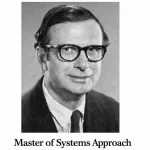
One of the most famous thinkers in this field, Russell Ackoff, argued that managers don’t face simple problems; they face Messes.
A “Problem” is like a puzzle piece—it has a clear shape. A “Mess” is a system of problems that are so tangled together that you cannot solve one without affecting all the others.
- A Problem: “The printer is broken.” (Technical/Hard)
- A Mess: “Our employees are unhappy, which leads to bad customer service, which leads to lower sales, which makes the board of directors cut the budget, which makes the employees more unhappy.” (Social/Soft)
Soft Systems Thinking gives us the tools to navigate these messes by talking to the people involved and mapping out their different points of view.
Critical Systems: Who Benefits?
While “Soft” systems focus on understanding everyone’s perspective, Critical Systems takes it a step further. It asks a tough question: “Who has the power?”
Critical systems thinkers believe that some perspectives are often silenced. If a company is designing a new factory, they might listen to the CEO and the engineers, but ignore the people living next door to the site.
The “Critical” part of this field is about:
- Ethics: Ensuring the solution is fair.
- Power: Identifying who is making the rules.
- Boundary Critique: Deciding who is “in” the system and who is being left “out.”
The Goal: Not “The Best,” but “The Better”
In Soft and Critical Systems, we give up on the idea of a “perfect” solution. Because people change, the system changes. Instead, we look for meaningful improvements that the people involved can actually agree on.
Success is not a destination, but a continuous process of learning. In soft systems, the model is not a map of the world, but a tool to help us have a better conversation about the world.
Conclusion
Soft and Critical Systems marks the moment where systems thinking becomes a social tool. It acknowledges that the world is messy, that people are complicated, and that power is rarely shared equally. By shifting our focus from “fixing machines” to “facilitating people,” we can tackle the big, tangled messes that technical science can’t touch.