If you have ever tried to adjust the temperature of a shower and ended up going back and forth between scalding hot and freezing cold, you have experienced the damage caused by a time delay in a feedback loop.
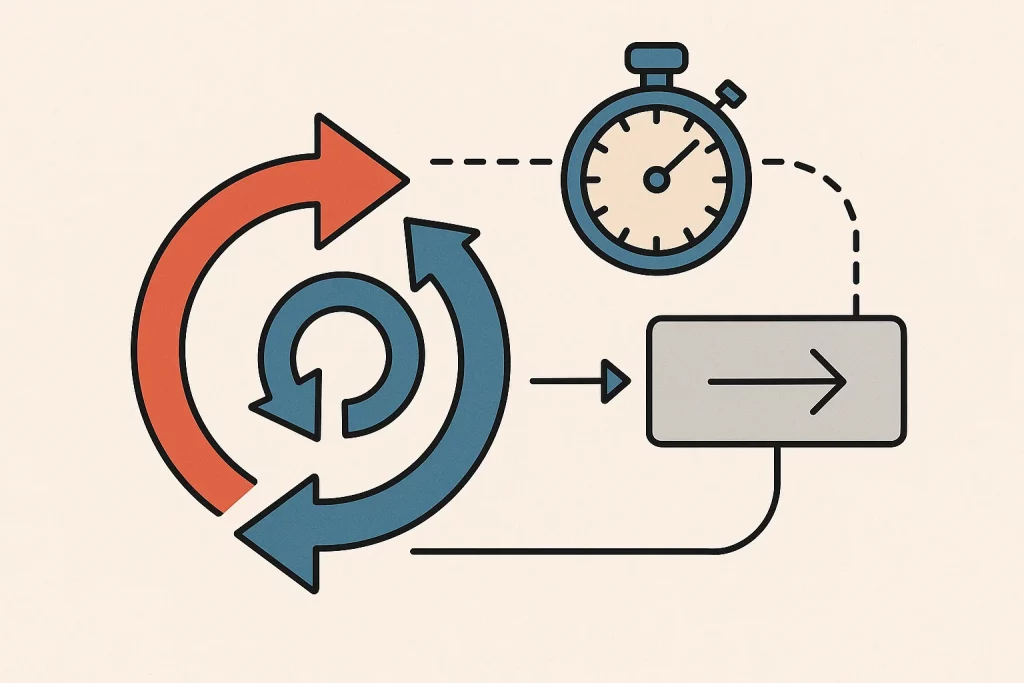
In theory, the negative feedback loop should perfectly maintain stability (homeostasis). But in reality, almost all systems contain delays. A time delay is the period between when an action occurs and when its full effect is sensed, measured, and used for correction.
The presence of delays turns a smooth, stable system into an oscillating, chaotic, or even collapsing system. Understanding time delays is essential because they are the root cause of overreaction and chronic instability in everything from supply chains to the economy.
1. The Anatomy of a Time Delay
A time delay is a lag that exists anywhere in the closed loop of cause and effect. Delays can occur in three main stages:
Delay in Sensing
This is the time it takes for the system to notice that a change has occurred.
- Example: It takes two seconds for the thermometer in a room to register the true temperature change after the heater turns on.
Delay in Decision
This is the time it takes for the controller (the manager, the brain) to process the information and decide on a corrective action.
- Example: A manager receives a sales report but takes one week to analyze the data and approve a new marketing strategy.
Delay in Action
This is the time it takes for the corrective action to take its full effect on the system.
- Example: A marketing campaign is launched, but it takes three months before new customer orders actually arrive and impact revenue figures.
2. Overshoot and Oscillation
The primary problem caused by a time delay is overshoot, which leads directly to oscillation. This transforms a stable, goal-seeking system into one that constantly swings wildly past its target.
The Overshoot Problem
Imagine the shower again. You turn the hot water on. There is a two-second delay before the hot water reaches the showerhead.
- Goal: Warm water.
- Action: Since the water is cold, you aggressively turn the hot knob up.
- Delay: You wait for two seconds, but the water is still cold because the hot water is still in the pipe.
- Overshoot: You turn the hot knob up even further (an aggressive correction based on old information).
- Two seconds later, the original hot water and your extra hot water both arrive, causing the temperature to drastically overshoot the goal and become scalding.
The Cycle of Oscillation
The system is now too hot, so you turn the cold knob way up (a massive, delayed negative correction). This action then creates an overshoot in the opposite direction, making the water freezing cold. The system is trapped in a continuous cycle of over-correcting, never stabilizing at the goal.
This phenomenon is exactly why Norbert Wiener’s work on control systems emphasized speed and accuracy in sensing and processing information. Slow, delayed information is worse than no information at all.
3. Delays in Large Systems
In large, complex systems, delays amplify instability and can lead to massive economic problems.
The Bullwhip Effect in Supply Chains
The Bullwhip Effect is a classic example of delayed feedback.
- A small, sudden increase in customer demand occurs.
- The retailer (Stage 1) experiences a short delay and orders a bit more.
- The wholesaler (Stage 2), due to a longer delay in receiving the order and assessing trends, overreacts and orders much more from the factory.
- The factory (Stage 3), seeing massive, delayed orders from all wholesalers, panics and orders raw materials for a huge surge in production.
By the time the factory’s massive production reaches the market, the original customer demand has disappeared. The system has wildly overshot the goal, leading to huge inventories, wasted resources, and sudden collapse.
Policy Failure
In government, policy often fails due to long decision and action delays. A government may pass a stimulus bill based on economic data that is already six months old. By the time the bill’s effects finally hit the economy 18 months later, the original problem may have already fixed itself, causing the delayed stimulus to trigger a new problem like inflation.
The Key Insight: For Systems Thinkers, the most dangerous part of a negative feedback loop is not the action itself, but the time delay between the action and the reaction. Eliminating, reducing, or at least anticipating these delays is necessary for any system to achieve true, non-oscillating stability.
Conclusion
Time delays are the great paradox of feedback: they turn the stabilizing force of a negative loop into a source of chaotic oscillation. Because all real-world systems, from mechanical controls to human supply chains, contain delays, they are inherently prone to overshooting their goals. The goal of Cybernetic design is to identify where delays exist—in sensing, decision, or action—and implement strategies to minimize them, allowing the system’s control mechanisms to operate effectively and achieve true, non-oscillating stability.